

Whether you’re answering calls every shift or only a handful each year, you need to trust your hose every time it comes off the rig.
In the field, fire hose is exposed to harsh environmental hazards, including carcinogens, chemicals, oils, and more. That’s why regular service testing and proper maintenance aren’t optional; they’re essential.
So, what makes a hose truly dependable? It starts with quality, durable, performance-rated materials, but it doesn’t end there. A reliable hose must also meet National Fire Protection Association (NFPA) requirements, specifically NFPA 1962.
Annual testing and inspection play a critical role. While no test can prevent every failure, routine hose inspections and equipment maintenance help extend service life and, more importantly, protect firefighter safety.
Consistent inspections, regular maintenance, and daily care are key. Keep reading to learn why hose service testing, and strict adherence to NFPA 1962, matter on every call.
What is NFPA 1962?
NFPA 1962 is the standard for care, use, inspection, service testing and replacement of fire hose, couplings, nozzles and fire hose appliances. It lays out timelines for testing and record-keeping, as well.
All fire hose must be service tested before being placed into service, or no later than one year from its date of manufacture. Once in service, department hose should undergo service testing at least annually.
Service test records should be maintained as part of the department’s equipment inventory. This inventory should document key details, including but not limited to:
- Assigned identification number
- Vendor
- Size and length
- Type of hose
- Date received and date put in service
- Date of each service test and the service test pressure
- Repairs and damage
- Reasons removed from service
If you’re looking for an easier way to capture this information, consider using Snap-tite’s Hose Record Vault app. This program features cradle-to-grave tracking and all you have to do is fill it out. It’s accessible via any web browser and is downloadable from the Apple App and Google Play stores.
Back to testing. Service testing standards differ by hose type, so make sure you’re testing to the correct pressure.
- Attack hose: Service tested to a minimum of 300 psi or a pressure not to exceed the service test pressure marked on the hose.
- Supply hose: Service tested to a minimum of 200 psi or a pressure not to exceed the service test pressure marked on the hose
- Booster hose: Service tested to 110 percent of its maximum working pressure.
What Should I Look for When Inspecting my Hose?
Before performing any annual hose service testing, you’ll want to complete your fire hose inspection. Check for:
- Jacket damage: Damage can result from cuts, cracks, abrasion, vermin, chemical exposure, or burns. If the hose cannot be service tested due to this damage, remove it from service until it is repaired or condemned.
- Mildew or rot: This typically occurs when hose is not properly dried and stored after use.
- Coupling damage or slippage: Visually inspect couplings for cracks, dents, or corrosion, and confirm they are securely attached. Check for coupling slippage following service testing.
- Gasket condition: Ensure coupling gaskets are intact and in good working condition; replace them as needed.
- Liner damage: Inspect the liner at both ends of the hose for signs of delamination. If delamination is present, remove the hose from service.
- Flexibility: While handling the hose, check for stiff or soft spots by flexing and bending it. If cracks or flattened areas are found, remove the hose from service.
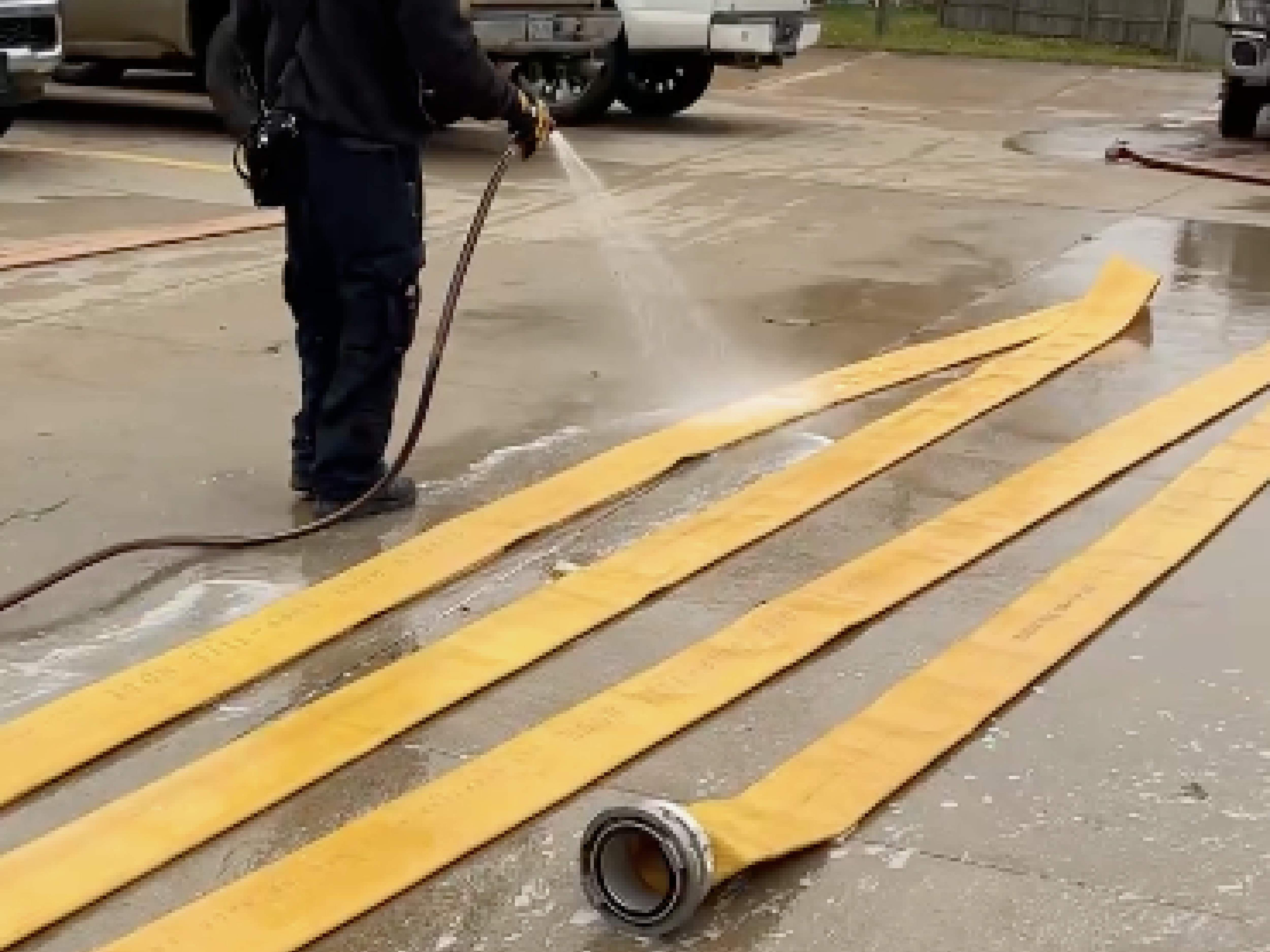
You can also look for these types of damage after routine calls. While cleaning hose post-fire, you may notice heavy abrasion, damaged couplings, or cracking—some of the most common issues found in fire hose.
What are Some Fire Hose Testing Best Practices?
After you’ve completed your hose inspection, it’s time to service test. Hose service testing can be done using a hose testing machine, a stationary pump, or a pump on your fire department apparatus. You can also contract with a third-party vendor to complete testing for you.
When preparing to service test, here are some tricks to remember:
- Lay your hose in a straight line without kinks or twists.
- Hose 3.5 in. and larger must be tested while lying on a horizontal surface.
- 300 ft. of hose is the maximum length that can be tested.
No matter which of the three testing methods you use, safety must always come first. Hose failure can cause serious injury, making it critical to follow NFPA 1962 hose testing procedures.
If you’re using a hose testing machine, it must be pressure tested for leaks before use. When testing with a stationary or apparatus pump, install a hose test valve—a fire department gate valve with a 1/4-inch hole drilled through the gate—between the pump and the test hose. Any pressure gauges used during testing must have been serviced within the past 12 months.
- Connect the test hose to the appropriate valve on your machine or pump.
- Attach a test cap to the free end of your test hose. A nozzle with a non twist shutoff can also be used. Secure your test hose with a belt tie-in or rope hose tool 10-15 in. from the coupling.
- Flow water to the test hose, gradually raising the pressure to 45 psi (+/- 5 psi).
- Remove all air from the test hose before continuing with service testing.
- Slowly close the nozzle or test cap valve, and then close the test valve attached to your machine or pump.
- Secure the free end to avoid whipping in the event the hose bursts.
- Check couplings for leakage and tighten if necessary. Use a marker to indicate your coupling location so you can check for slippage post test.
- Have all nonessential personnel clear the area for the remainder of the procedure.
- Slowly increase pressure no faster than 15 psi per second until attaining the service test pressure. Maintain for 3 minutes.
- Perform a visual inspection of the hose at test pressure, being sure to stay 15 ft away at all times and steering clear of the free end of the hose.
- After 3 minutes, shut down the pump, open the hose test valve to let pressures equalize and then drain water from the cap or nozzle.
- Check your coupling marks and record your testing results.
If a hose bursts or leaks are noticed, terminate the test. Determine the source of the leak and fix it if possible, then re-test the hose. Make sure to track the results of your hose service testing whether you use the Hose Record Vault or your own record-keeping system.
What are Common Hose Failures and How Can I Prevent Them?
Fire hose takes a lot of abuse. On the fireground, it’s exposed to heat and cold, debris, chemicals, and more; conditions that can shorten its expected 10-year service life. Proper preventative maintenance, however, can help extend its lifespan and keep it performing reliably.
After every fire, cleaning your hose is essential. Once cleaned, ensure it’s fully drained and dried before storing or repacking on the apparatus. Avoid drying hose on hot pavement or in direct sunlight. Instead, hang it to dry or use a hose dryer to ensure complete drying. Finally, store hoses in a dry, well-ventilated area to protect them from damage.
How Does Construction Impact Hose Performance?
Like with most things, the better the materials you use, the better quality it will be. Fire hose made with quality and durable materials will continue to perform, even in extreme conditions. It’s less likely to degrade over time and can continue to pass annual service testing.
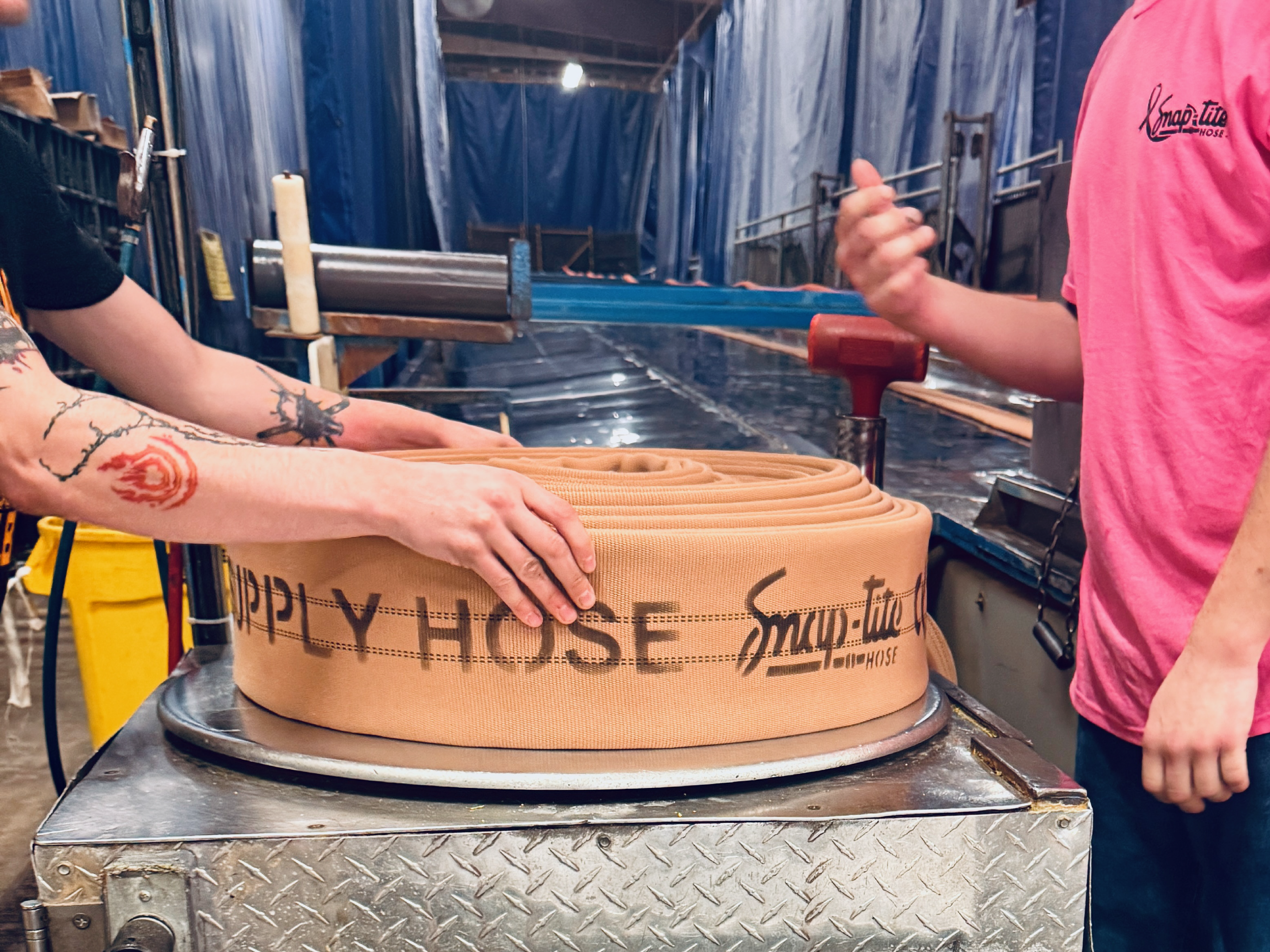
At Snap-tite Hose, we take pride in being American-made, using only the most reliable, performance-tested materials built to withstand the toughest and most demanding environments. Our hoses are engineered to perform under extreme conditions while meeting ISO 9001:2015 certified quality management standards. Every Snap-tite Hose—not just a sample from each batch—is service tested before it leaves our facility. With these high standards, you can trust that when people rely on you, you can rely on us and our products.
Final Thoughts
In the end, a fire hose is only as reliable as the care, testing, and materials behind it. Regular inspections, proper maintenance, and adherence to NFPA 1962 standards help extend hose life and keep firefighters safe. High-quality construction, like that of Snap-tite Hose, ensures performance even in extreme conditions, while service testing and proper storage protect your investment. When every call matters, you can trust that well-maintained, quality-tested hose will perform—and that you can rely on the products supporting you on the fireground.