

Crosslays are a critical component of hose deployment strategy. Also known as speedlays in some departments, crosslays are pre-connected hose lines packed on the apparatus so that they can be pulled and charged quickly. When seconds count, and on most fires they do, the way hose is packed and stored can directly affect how quickly and efficiently a crew can begin fire suppression.
Here we share more on five popular crosslay styles, their pros and cons, and additional factors to consider when choosing one (or more) for your department apparatus.
What is a Crosslay and Why Does Setup Matter?
A crosslay is a hose line (usually 1¾" or 2½") that is pre-connected to a discharge on an engine or pumper. Crosslays are typically found in compartments or on trays at the side or rear of the apparatus for one-person or two-person deployments.
A well-designed crosslay system matters because:
- It reduces deployment time, allowing crews to get water on fire faster.
- It reduces hose drag and kinks, making advancement easier.
- It improves safety, by minimizing crew fatigue and confusion during high-stress incidents.
- It guides training consistency, so all crews pull and feed lines the same way.
How the hose is packed and routed directly affects how quickly it can be charged and advanced, and whether the firefighter deploying the line must stop, untangle, or re-orient the hose under pressure.
What are the Pros and Cons of Popular Crosslay Styles?
The crosslay that works for one department won’t necessarily be the best choice for another. That’s why there’s a variety of options to choose from. Let’s talk more about five popular styles.
Flat Load
The flat load is the simplest crosslay configuration. Hose is laid back and forth in flat layers across the tray or compartment, with no folding or special packing pattern. The female coupling end is typically placed nearest to the firefighter’s reach, with the male on the back end so it is pulled first.
When the line is pulled, the male coupling and initial hose feed out from the bottom of the stack. The rest of the line lies flat and feeds smoothly as the firefighter pulls the hose.
Pros:
- Extremely simple and intuitive.
- Easy to repack after use.
- Works well with both 1¾" and 2½" hose.
- Fewer twists, reducing chance of kinks.
Cons:
- Does not pre-orient hose direction; the firefighter must control hose rotation manually.
- On long hose beds or deep compartments, friction may increase, slowing feed.
- Not ideal for single-handed deployment in tight spaces.
Fireground Performance:
The flat load works for departments that value simplicity and ease of repack. On open streets or wide driveways, the flat load feeds well with minimal effort. However, in crowded alleyways or tight doorways, the load may require more hand control to prevent twists.
Minuteman Load
The minuteman load is one of the most commonly recognized crosslay configurations. It is a variation of the flat load designed for rapid, single-firefighter deployment. The hose is folded in alternating directions so that it feeds off the shoulder with minimal drag.
The hose is packed in S-shapes (“zig-zag”) with each fold oriented so that when pulled from the nozzle end, the next section of hose automatically feeds straight with little or no adjustment.
Pros:
- Excellent for rapid attack with one firefighter.
- Reduces hose drag and twisting.
- Very predictable deployment.
- Easy to train on.
Cons:
- Packing takes more time and skill.
- Repack requires attention to maintaining folds.
- Slightly more complex than flat loads.
Fireground Performance:
The minuteman load shines when speed and efficiency matter. A single firefighter can shoulder the hose, drop the nozzle and pull efficiently without fighting kinks. Departments that do a high volume of structure fires or rapid interventions often prefer this load because the initial line can be deployed with remarkable efficiency.
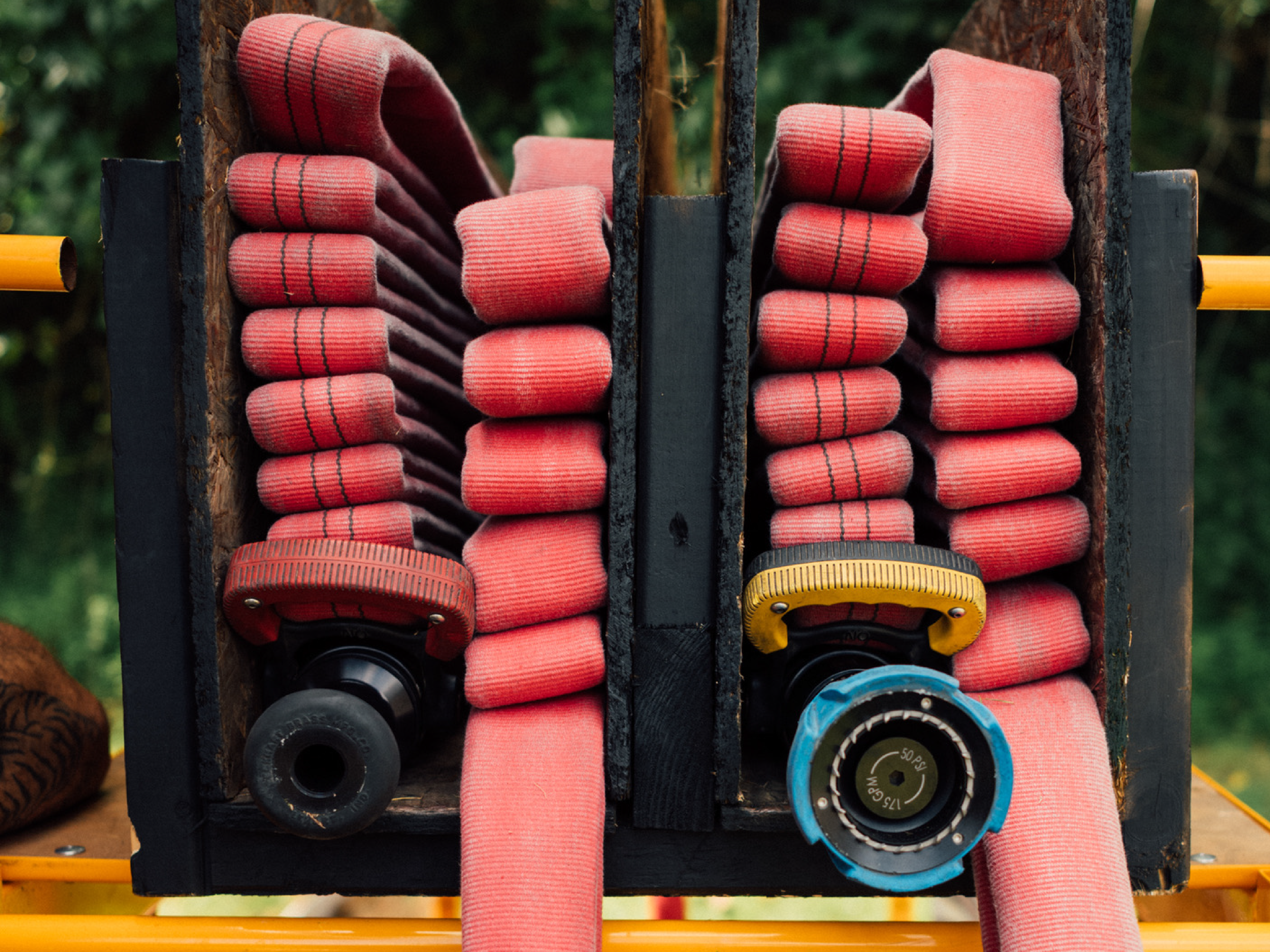
Accordion Load
The accordion load lays the hose in alternating vertical folds. Instead of lying flat, each fold stands on end like the bellows of an accordion. When pulled, the folds collapse and feed out horizontally. The orientation of the folds helps reduce kinks and encourages smooth deployment.
Pros:
- Very low chance of hose twisting.
- Feeds easily off the shoulder.
- Great for rapid deployment in confined spaces.
Cons:
- Takes practice to pack properly.
- Can be bulky in smaller compartments.
- Not as common so crews may require extra training.
Fireground Performance:
Accordion loads perform well in confined spaces like narrow streets or building interiors because the hose feeds out without needing the firefighter to twist or adjust the orientation. The vertical folds act like a controlled release system.
Reverse Horseshoe Load
The reverse horseshoe load organizes the hose in large u-shaped loops laid in the bed. The hose forms a “horseshoe” shape with the ends of the loops facing toward the front of the apparatus. The coupling is positioned so it can be pulled from either side.
When the firefighter pulls the line, the loops unwrap evenly on both sides, allowing bi-directional deployment depending on which side is needed.
Pros:
- Works well on wide hose beds.
- Reduces friction due to even loop distribution.
- Can be accessed from either or both sides.
- Good for departments with multi-direction deployment.
Cons:
- Loop orientation can be confusing without training.
- Harder to repack neatly for crews unfamiliar with the system.
- Slightly slower than minuteman for single-person pulls.
Fireground Performance:
On larger apparatus with wide hose beds, the reverse horseshoe load allows multiple firefighters to pull from either side without interference. It’s particularly beneficial when multiple crosslays are staged side-by-side, reducing hose crossover and snarls.
Triple-Layer Load
The triple-layer load is often used for larger diameter lines like 2½" or supply lines such as LDH on pumpers. The hose is layered in three distinct horizontal levels, which helps manage bulk and friction.
When pulled, the hose comes off in a controlled fashion as the layers peel off one by one. This method reduces overall drag and allows multiple firefighters to help feed line.
Pros:
- Great for large diameter hose (2½" or greater).
- Reduces drag and makes big hose manageable.
- Allows coordinated pulling by multiple firefighters.
Cons:
- Not ideal for rapid attack with 1¾" — overkill for small lines.
- Packing and repacking can be laborious.
- Requires training to ensure layers release properly.
Fireground Performance:
For supply lines or heavy attack lines, the triple-layer load offers the best balance of size control and friction management. It’s especially useful on long supply stretches from hydrants or drafting, where friction loss and drag can slow advancement.
Why Does Setup Matter and What to Consider?
Here are some other factors to consider when picking a fire hose crosslay for your department:
- Speed and Surprise: Fire behavior can shift rapidly. A crosslay that deploys quickly gives the crew the ability to apply water sooner, slowing fire growth and improving occupant survival.
- Crew Safety: Less hose drag and fewer kinks mean firefighters can focus on tactics, not equipment. Loads that feed smoothly reduce physical strain and tripping hazards.
- Consistency and Training: Standardized loads allow departments to train all members to expect the same behavior from every line. Whether it’s a rookie on the nozzle or a veteran officer, consistent hose behavior minimizes confusion under stress.
- Apparatus Design and Space Utilization: Some crosslays fit better in certain apparatus layouts. Reverse horseshoe works well on wide beds; Flat loads maximize vertical compartment space; Triple-layer manages bulky, large-diameter hose.
- Adaptability: Departments with diverse responses such as high-rises, industrial, and residential, may choose different loads for different rigs. A heavy rescue might carry accordions for confined spaces, while a ladder company may prefer minutemen for speed.
- Hose Packability: Not all hose is created equal, and the hose packed on your rig matters just as much as how it’s packed. Snap-tite Hose is manufactured to be flexible, compact and low-profile so you can pack and pull with ease.
How Do I Pick the Right Crosslay for my Department?
No one fire hose crosslay configuration is universally “best.” Each has been developed to solve a particular set of challenges; rapid deployment, minimal drag, ease of repack, directionality or size management. The best choice for any department depends on:
- Response area and building types
- Crew size and proficiency
- Apparatus layout
- Common tactical needs
Picking the right crosslay for your department is an important choice that takes consideration. By understanding the differences crosslays and their own needs, fire departments can optimize their apparatus and training to meet real-world demands.
To learn more about hose that sets the industry standard in quality and safety in lay-flat hose, check out our website today.