

It’s a classic question: rubber or double-jacket supply hose? Both will move water from point A to point B, but the right choice depends on what your department needs most.
Material, weight, and durability all play a role, as do crew size and the types of calls you run. Each option has advantages depending on how and where you operate.
Dive into our side-by-side comparison below to see which supply line is the better fit for your department.
Rubber Supply Hose
Rubber supply hose features a rubber outer cover rather than a traditional protective jacket. Many departments choose it because it’s:
- Lightweight, even when wet, for easier handling
- Simple to clean and wipe down after use
- Highly durable and resistant to chemicals, oils, and other compounds
- Naturally resistant to mildew and rot
- Tough against abrasion and difficult to puncture
Rubber hose does come with trade-offs. It can be less flexible than jacketed hose and may offer lower pressure ratings than double-jacket constructions.
Snap-tite solves these challenges. Our rubber hose incorporates a circular woven polyester jacket that’s fully encapsulated by an extruded, thru-the-weave nitrile cover. While typical rubber-extruded hose can vary in thickness, our manufacturing process ensures consistency, durability, and efficient packability.
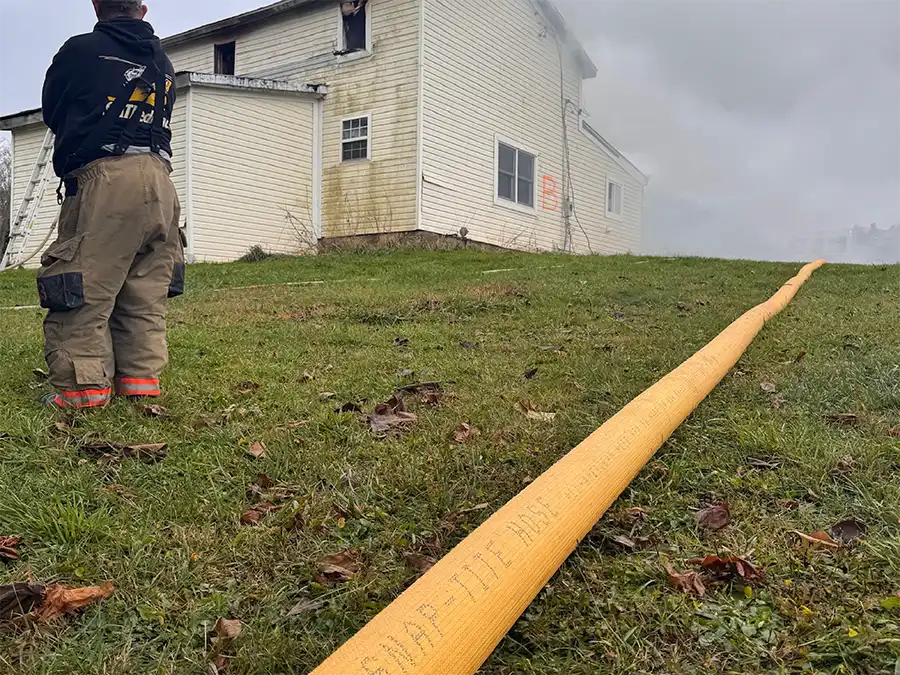
HFX™ is a prime example. Built and tested to the highest standards, its extruded thru-the-weave nitrile rubber cover and engineered surface ribs deliver superior puncture and abrasion resistance. It’s kink-resistant, snag-proof, guaranteed for life to never delaminate, and protected by a 10-year warranty.
Double-Jacket Supply Hose
Double jacket hose features an inner liner protected by two woven synthetic layers, often made from high-strength polyester. This dual-layer construction delivers added strength, durability, and abrasion resistance.
Departments that choose double jacket supply hose often do so because it’s:
- Built for higher pressures
- Exceptionally strong and long-lasting
- Resistant to mold and rot
- Highly abrasion and puncture resistant thanks to its two-layer design
- Naturally kink- and twist-resistant
Double jacket hose does come with a few considerations. It can be heavier, especially when wet, more difficult to clean, and slightly more expensive due to its dual-layer build.
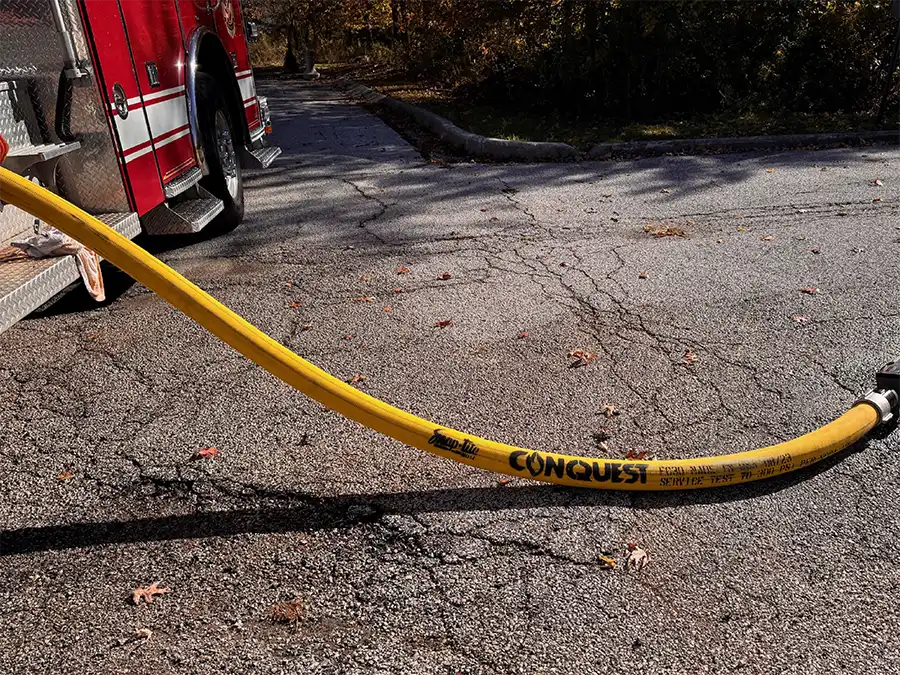
Conquest™ LDH is a standout example of a premium double-jacketed supply hose. Constructed with a 100% high-tensile polyester outer jacket and an extruded thru-the-weave polyurethane inner hose, Conquest™ delivers a smooth waterway that improves flow and reduces friction loss. It’s also guaranteed to never delaminate, and comes equipped with a 10-year warranty and a 2-year all-hazard warranty for on-the-job damage.
Which Hose Makes Sense for Your Department?
Choosing the right LDH for your department comes down to how it will be used and the size of your responding crew.
Rubber and double jacket supply lines share key qualities. Both hose types are durable and abrasion-resistant, but they differ in weight and how easy they are to clean.
With firefighter cancer rates on the rise, ease of cleaning is more important than ever. Hose can pick up dangerous debris on the fireground, and simplifying the cleanup process helps reduce exposure to carcinogens, protecting both your firefighters and your department.
Double Jacket Supply Hose
For paid departments with full, experienced crews, double jacket supply line can be an ideal choice. It excels at moving large volumes of water at high pressure, especially in smaller diameters like 3”. This hose performs best in environments with minimal exposure to chemicals or oils. If your department has the budget for it, double jacket hose also offers the advantage of a longer service life, making it a smart long-term investment.
Rubber Supply Hose
On the other hand, if your department often responds with smaller crews, has limited resources, or doesn’t need to move water at high pressure, rubber hose is an excellent option. Its lightweight, durable construction makes it easier for a 2–3 person crew to deploy, maneuver, and clean. Rubber hose is abrasion- and puncture-resistant, and it performs especially well in environments where firefighters encounter chemicals, oils, or other hazardous compounds.
American-Made Hose That Sets the Standard
With Snap-tite Hose on your apparatus, underperforming hose is never a concern. We set the industry standard for quality and safety in municipal lay-flat hose. Made in America from domestically-sourced, high-quality materials, Snap-tite Hose delivers water where it’s needed every time. Performance-tested and NFPA-compliant, our hoses guarantee reliable results on the fireground.
All Snap-tite supply hoses, rubber and double jacket, are manufactured in Erie County, PA. With over 55 years of refining our processes, we proudly produce hoses that meet strict quality benchmarks. As the only ISO 9001:2015 certified hose manufacturer in North America, every hose we make is individually quality tested—not just a sample from each batch.
Answer the Call with Snap-tite
From a fully-involved two-story residential fire to a small vehicle fire on a back road, Snap-tite Hose performs when it matters most. Our lay-flat hoses are designed for reliability and durability in an industry where failure isn’t an option. Every hose is tested and certified, so you can trust your equipment every time your rig rolls out.
Want to learn more about our rubber and double jacket supply hoses? Contact a Snap-tite salesperson to discuss your department’s specific needs.
Already sold on Snap-tite but still deciding which hose is right for you? Request a fire department demo today! Fill out the required information, and a Snap-tite representative will arrange a hands-on demonstration so you can see our hose’s superior performance firsthand.